
Search中文
Our Mission
We are dedicated to achieving breakthroughs in fundamental theory, algorithmic innovation, and system development, while nurturing visionary leaders with a global perspective.
“Seeking Truth, Pursuing Innovation.”
To build a world-class hub for AI research and talent cultivation.
2026-02-27
G protein–coupled receptors (GPCRs) are among the most important “signal receivers” in the human body, translating external stimuli into internal signals that govern sensation, mood, cardiovascular function and metabolism. These seven–transmembrane-helix proteins are also pharma favorites. More than a third of marketed drugs act by nudging GPCR activity. But many therapies still aim at a familiar target region: the orthosteric pocket where natural ligands bind, and that approach can struggle when disease arises from structural defects rather than a missing “on” signal.
Now, researchers at Zhejiang University report an unconventional approach: rather than pushing the receptor's canonical “start button”, they wrap it in an engineered, membrane-embedded scaffold that constrains its motion and reshapes its output. ZHANG Yan's team at the School of Medicine and the Liangzhu Laboratory worked with ZHANG Min's team at the College of Computer Science and Technology, proposed de novo–designed “GPCR Exoframe Modulators” (GEMs) that function like a modulatory exoskeleton.
During signaling, GPCRs undergo a distinctive seesaw-like conformational shift, converting external stimuli into intracellular responses. Traditional drug discovery typically aims to trigger or block this process by occupying the orthosteric pocket. “You can think of it as the receptor's start button,” says ZHANG Yan. But that framing exposes a limitation: hundreds of mutation-linked disorders can distort GPCR structures, leaving receptors misaligned, jammed or overly active, and drugs tuned to the orthosteric site often cannot restore proper mechanics.
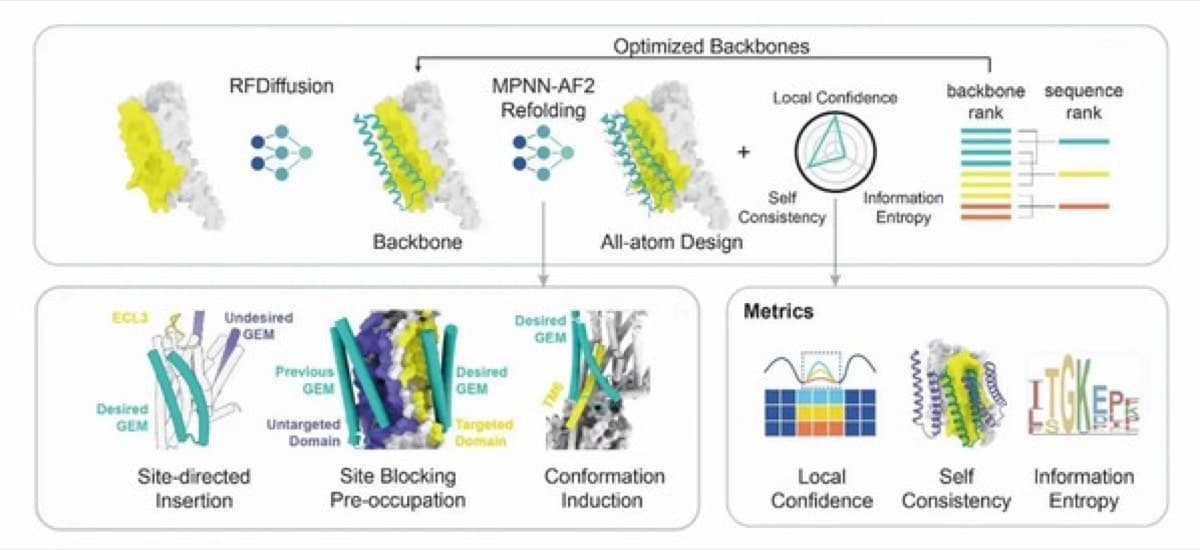
The team's idea was to design transmembrane protein partners that bind GPCRs at selected interfaces and stabilize specific conformations — essentially providing a “behavioral constraint” without replacing the receptor's ability to sense its environment. GEMs can also be fused with GPCRs, expanding the classic seven-pass architecture to nine or even thirteen transmembrane segments, acting as a structural framework that biases how signals are transmitted.
The authors report close consistency between predicted and measured structures, with an accuracy approaching 1.0 Å. “We're not just turning receptors on or off,” says ZHANG Min. “The system offers a degree of programmability.” ZHANG Yan uses a cultural metaphor: if GPCRs are like Sun Wukong, the Monkey King famed for taking on hundreds of forms, then GEMs resemble the tightening headband that reins in his movements.
“We hope this approach can offer new therapeutic ideas for GPCR dysfunction diseases that have long lacked effective interventions, for example, certain Parkinson's disease,” says ZHANG Yan.
Translator: FANG Fumin. Editor: HAN Xiao.