
Search中文
Our Mission
We are dedicated to achieving breakthroughs in fundamental theory, algorithmic innovation, and system development, while nurturing visionary leaders with a global perspective.
“Seeking Truth, Pursuing Innovation.”
To build a world-class hub for AI research and talent cultivation.
2025-08-26
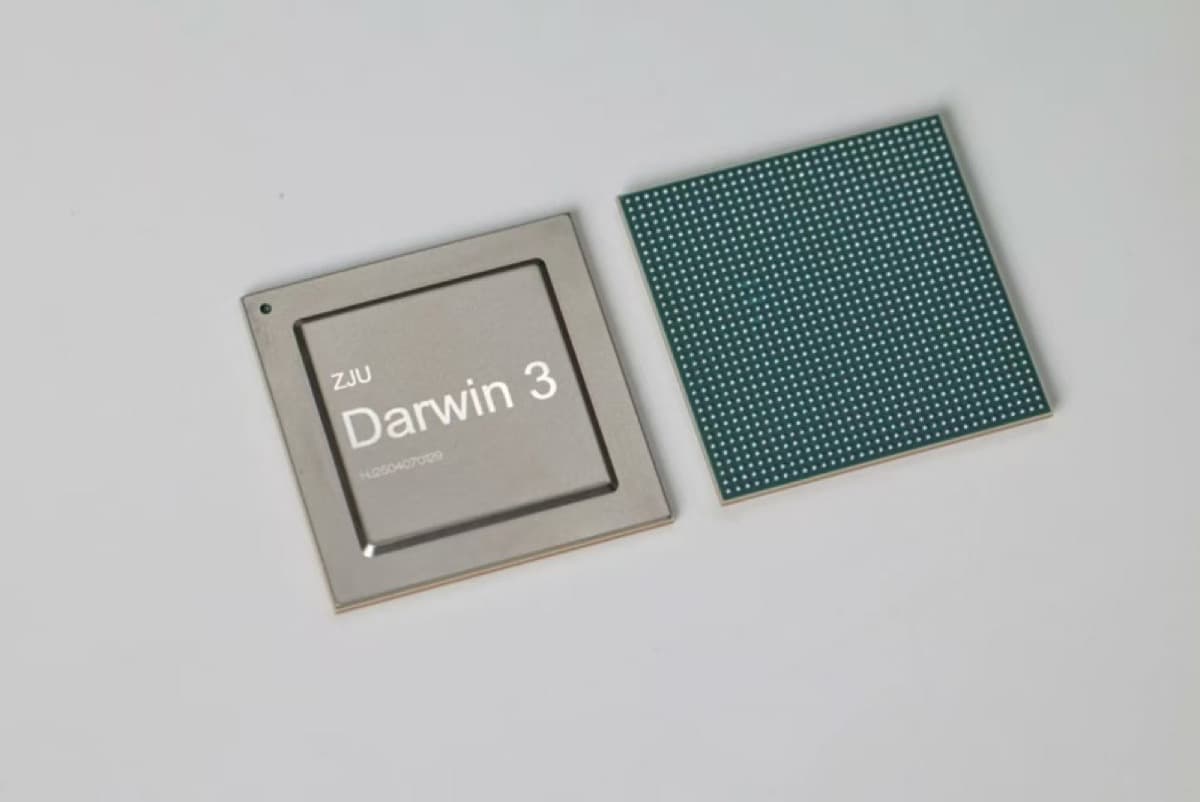
In a breakthrough that pushes the boundaries of artificial intelligence and neuroscience, researchers at Zhejiang University have unveiled Darwin Monkey (“Wukong”) — the world's first brain-inspired computer powered by a dedicated neuromorphic chip with more than two billion neurons. The achievement positions China at the forefront of global neuromorphic computing research.
The human brain is an extraordinarily efficient computing system, capable of integrating vision, hearing, language, learning, reasoning, decision-making, and planning. Brain-inspired computing applies the operating mechanisms of biological neural networks to computer system design, creating low-power, highly parallel, efficient, and intelligent computing systems similar to the brain.
“Wukong” consists of 15 blade-type neuromorphic servers, each containing 64 Darwin-III chips. Its neuron count approaches that of a macaque brain. Under typical operating conditions, it consumes just 2,000 watts — remarkably low given its scale. The Darwin-III chip, jointly developed by Zhejiang University and Zhijiang Laboratory in early 2023, supports more than 2.35 million spiking neurons and over 100 million synapses per chip, and supports real-time online learning.
To overcome limitations in inter-chip communication and energy efficiency, the team collaborated with the College of Integrated Circuits to develop the Darwin Wafer — an ultra-integrated, wafer-level brain-inspired chip built using advanced 2.5D CoWoS-S packaging technology. The result is a System-on-Wafer (SoW) blade server whose core is a single 12-inch wafer integrating 64 Darwin-III chip dies.
Over more than two years, the researchers achieved multiple technical firsts: a scalable multidimensional grid topology for chip-to-chip communication, a dynamic time-step control mechanism, wafer-level integration combining domestic manufacturing with advanced packaging, and a multi-tier resource management system for scheduling and memory optimization.
On “Wukong,” the team has deployed several advanced applications, including the DeepSeek brain-inspired large model for logical reasoning and content generation, and simulations of the brains of C. elegans, zebrafish, mice, and macaques at different neuron scales — offering neuroscientists a powerful new research tool.
“With 'Wukong,' we are not only building faster computers, but we are also exploring a new way of computing. This is about understanding the brain, advancing AI, and rethinking how machines can learn.”
Source: ZJU English Portal. Translator: FANG Fumin. Editor: HE Jiawen, ZHU Ziyu.